
Company Blog
2026年3月7日
Essential Installation Guidelines for Industrial Chillers
Professional Installation Procedures for Industrial Chillers: A Practical Guide
In the modern manufacturing landscape, the installation of an industrial chiller is a critical step that dictates the long-term stability and efficiency of your production line. As a professional representative of a Chinese foreign trade factory with over ten years of industry accumulation, Yushine understands that "Efficiency Redefined" starts with a correct and practical setup. This guide provides a detailed, plain-English roadmap for installing your chiller to ensure it remains a "dependable asset" for your facility.
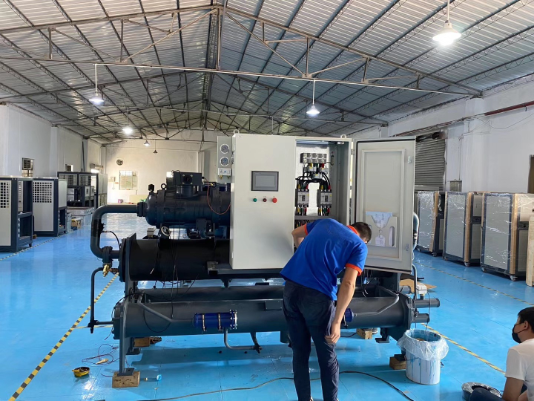
1. Site Selection and Foundation Requirements
The "Structural Integrity" of your installation begins with the ground beneath the machine. To ensure a "smoothest experience" during operation, the installation site must meet specific physical standards.
- Foundation Leveling: The installation site must be a solid floor, an installation pad, or a dedicated foundation.
- Precision Leveling: The horizontal level of the foundation must be within a tolerance of 6.4mm to ensure internal components are aligned correctly.
- Weight Capacity: The site must be robust enough to support the full operating weight of the unit during peak performance.
- Ambient Temperature Control: The unit should be placed in a machine room where the ambient temperature is maintained between 5°C and 45°C.
- Service Clearance: Sufficient space must be left around and above the unit to allow for daily maintenance and ventilation.
2. Strategic Maintenance Access
At Yushine, our "User-Centric" design philosophy prioritizes "Operational Practicality". This means planning for the future maintenance of the machine during the initial installation phase.
- Condenser Cleaning Space: At one end of the unit, you must leave enough "tube-pulling space" to allow for the cleaning of the condenser tube bundles.
- Creative Spatial Solutions: If space is limited, you may utilize doorways or other appropriately positioned openings to provide the necessary clearance for long-term servicing.
3. Water System Piping and Connectivity
The water circuit is the lifeline of the chiller. Proper piping ensures that heat is moved efficiently without creating "bottlenecks" in your cooling process.
- Pipe Sizing: Always select water pipes with diameters that match the requirements of the cooling and chilled water systems when the unit is running at maximum power.
- Flow Velocity Standards: For standard applications, the water flow velocity through the evaporator and condenser should be maintained between 1.0 and 3.6m/s.
- Flow Stability: In any load condition, the water flow rate must remain stable to prevent thermal fluctuations and potential system trips.
4. Piping Design and Mechanical Protection
To provide a machine "worthy of trust," the installation must protect the unit from mechanical stress and vibration.
- Standardized Installation: The design and installation of all chilled and cooling water pipes should follow conventional industrial methods.
- Pump Positioning: The chilled water pump must be located on the inlet pipe of the unit. This ensures positive pressure and consistent flow within the chiller.
- Stress Relief: Piping must have firm, independent supports to prevent any physical stress or weight from being applied to the chiller's components.
- Alignment: Hangers and supports should be positioned to facilitate easy pipe centering and alignment.
5. Vibration and Noise Control
A high-precision automation solution should be as quiet and stable as possible.
- Damping Components: Vibration-damping pipes should be installed to provide appropriate flexibility in the system.
- Drainage Prevention: The piping must be designed to prevent the evaporator water from draining out when the water pump stops.
- Vibration Isolators: For the best results in noise reduction and vibration control, it is highly recommended to install vibration isolators on the piping.
6. The Vital Importance of Water Quality
As a supplier of plastic processing auxiliary machinery, we emphasize that the "Material Integrity" of your water is just as important as the machine itself.
- Expert Analysis: For the most economical and effective use of your chiller, we suggest inviting a water treatment expert to analyze the water quality for both the evaporator and condenser.
- Scaling and Corrosion: Poor water quality leads to scale buildup, which interferes with heat transfer. It can also cause corrosion, sediment accumulation, and organic growth.
- Operational Costs: Neglecting water quality will significantly degrade the unit's performance and increase both running and maintenance costs over time.
Conclusion: A Reliable Future
Following these plain and practical installation steps ensures that your industrial chiller will provide years of reliable service. By focusing on a level foundation, proper clearance, stable water flow, and high water quality, you transform your cooling system into a high-efficiency tool for factory growth. Yushine remains committed to continuous improvement, helping our customers optimize their production through "User-Centric" engineering and dedicated technical support.