
Company Blog
2026年3月7日
Key Considerations for Dehumidifying Dryer Air Circuits
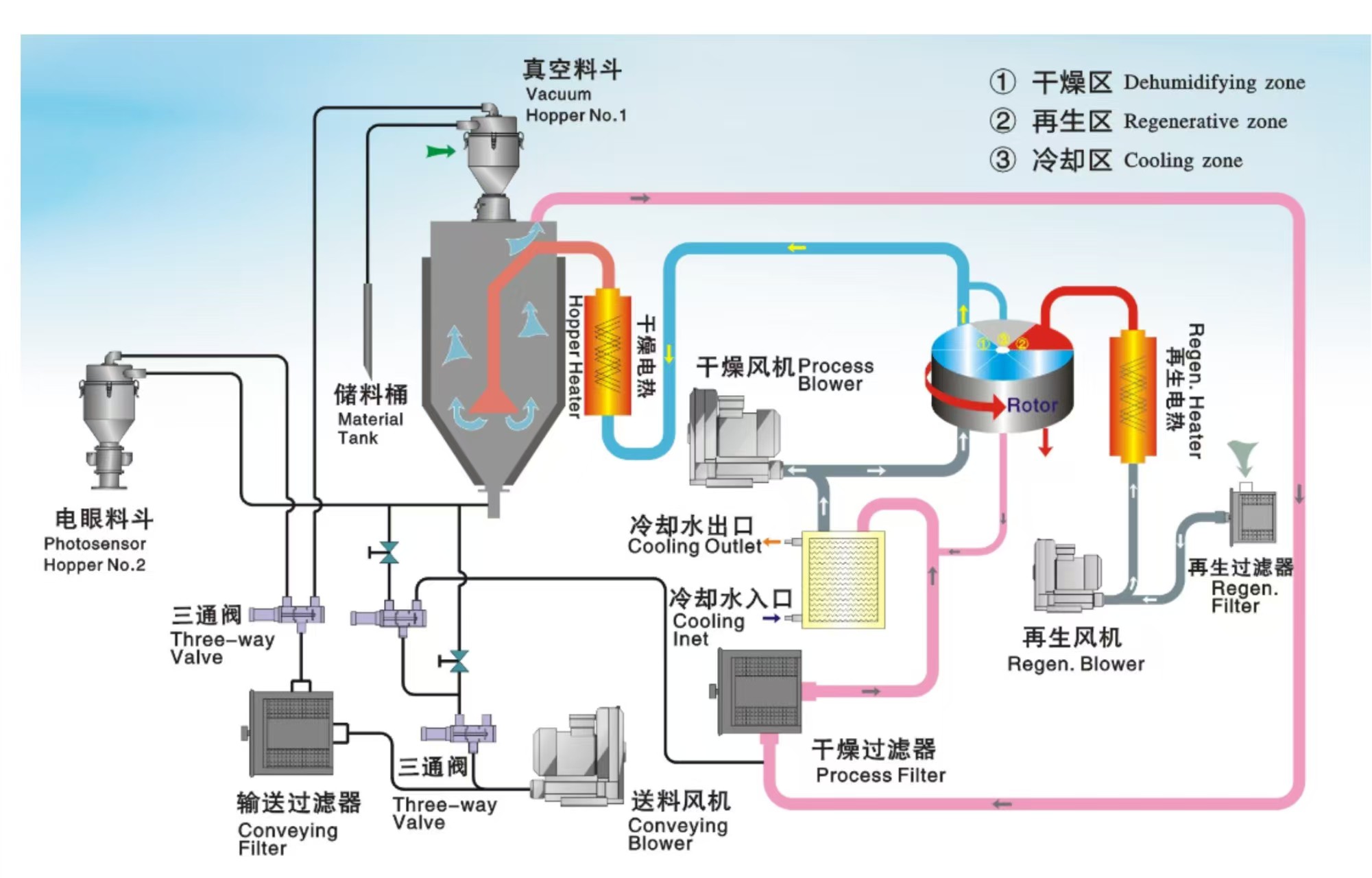
When operating a Dehumidifying Dryer , the drying air circuit is the heart of the process.
In the world of high-precision plastic manufacturing, the Dehumidifying Dryer is more than just a piece of auxiliary equipment; it is the gatekeeper of material quality. As a professional representative of a Chinese foreign trade factory specializing in plastic auxiliary equipment, Yushine understands that the "heart" of any drying system is its air circuit. When you are processing sensitive engineering resins like PET, PEEK, or Nylon, the integrity of this circuit determines whether your production runs smoothly or hits a costly "bottleneck".
1. The Critical Importance of Airtight Seals
The drying air circuit is a closed-loop system designed to isolate the material from the moisture in the surrounding environment. The most common enemy of a low dew point is not a machine failure, but a simple air leak.
- The Mechanism of Failure: If there is a gap in a pipe fitting or a worn-out gasket on the hopper lid, the blower creates a vacuum effect that sucks in humid workshop air.
- The Consequence: This ambient moisture overloads the honeycomb desiccant rotor, preventing it from reaching the necessary $-40^\circ\text{C}$ dew point.
- Practical Check: Regularly inspect all hose clamps and door seals. In our "user-centric" design, we emphasize using high-quality silicone gaskets that resist heat and maintain a perfect seal over years of operation.
2. Filter Maintenance: Ensuring Unobstructed Flow
The air circuit relies on a steady, high-velocity flow of air to carry heat into the material hopper and moisture out of it. If the air cannot move, the resin cannot dry.
- The Threat of "Fines": Plastic resin often contains small dust particles or "fines." As air cycles through the hopper, these particles are carried back toward the machine, where they get trapped in the return air filter.
- The Consequence: A clogged filter acts like a wall, forcing the blower to work harder while reducing the actual volume of air reaching the material. This leads to uneven drying and can cause the heating elements to overheat due to lack of airflow.
- Practical Check: Clean your return air filters daily. Our "Smart Design" incorporates easy-access filter housings so that operators can perform this task in seconds, ensuring the "smoothest experience" for your maintenance team.
3. Managing the Thermal Balance
Heat is the vehicle that carries moisture out of the plastic pellets. However, heat management within the air circuit requires a delicate balance between the heating and cooling stages.
Insulation for Efficiency
Every degree of heat lost through an uninsulated pipe is wasted energy. We advocate for "Operational Practicality" by ensuring all drying hoses are heavily insulated. This ensures that the air reaching the top of the hopper is just as hot as the air leaving the heater, providing consistent results from the first pellet to the last.
The After-Cooler Function
Before the humid return air passes back through the desiccant rotor, it must be cooled down. If the air is too hot, the desiccant cannot "grab" the water molecules effectively.
- Practical Check: Ensure your cooling water supply is stable. If the return air temperature entering the rotor is too high, your dew point will suffer, regardless of how new the machine is.
4. Monitoring Flow and Pressure Stability
A professional drying system is only as good as its consistency. In an increasingly competitive landscape, Yushine focuses on providing "Industry-First" stability.
- Balanced Airflow: If the airflow is too strong, it can blow the resin around inside the hopper, creating "channeling" where air escapes without drying the material. If it is too weak, the bottom of the hopper will be over-dried while the top remains wet.
- The Yushine Solution: Our 3-in-1 Dehumidifying Dryers utilize advanced PLC interfaces that allow you to monitor air pressure and flow in real-time. This "Smart Design" alerts the operator if a blockage occurs, preventing production downtime before it happens.
5. Desiccant Health and Dew Point Accuracy
At the center of the air circuit sits the honeycomb desiccant rotor. Its health is paramount.
- Avoiding Contamination: Certain materials release volatiles or "wax" when heated. If these vapors enter the air circuit without a specialized trap, they can coat the desiccant rotor, permanently reducing its ability to absorb moisture.
- Operational Practicality: If you are processing materials that outgas heavily, always install a secondary oil/vapor trap in the return air line. This small investment protects the "Structural Integrity" of your most expensive component.
6. The Human Element: Safety and Professionalism
Finally, the most important part of any air circuit is the person operating it. At Yushine, we believe a machine is only as effective as the team standing behind it.
- Professional Maintenance: If the air circuit malfunctions—for example, if the heater fails or the rotor stops turning—do not attempt a "quick fix" like a simple machine. These systems involve complex PID tuning and high-voltage components.
- Specialized Personnel: Always use specialized technical personnel for internal repairs to protect the equipment’s after-sales service and ensure long-term reliability.
- Pre-Shipment Guarantee: To give our clients a "machine worthy of trust," every Yushine dryer is unboxed, cleaned, and performance-tested before it leaves our factory. We provide live-action operational videos so you can verify the air circuit’s performance personally.
Conclusion
Mastering the air circuit of your dehumidifying dryer doesn't require an advanced degree in thermodynamics; it requires attention to detail and a commitment to "Operational Practicality". By keeping your seals tight, your filters clean, and your insulation intact, you transform your drying process from a potential bottleneck into a frictionless part of your production cycle.