
Company Blog
2026年3月9日
PLC Stability: The Case for Dual 24V Supplies
By ensuring core stability through physical isolation and minimizing the impact of field-level faults, manufacturers can achieve a frictionless production cycle.
In the realm of industrial automation, the Programmable Logic Controller (PLC) cabinet serves as the "brain" of the production line. Its reliability directly determines the stability of the entire manufacturing process.
This article explores the fundamental reasons why installing two separate 24V power modules is essential for modern PLC control cabinets, focusing on system architecture, electrical interference, redundancy, and maintenance practicality.
1. System Architecture: Achieving Physical Isolation
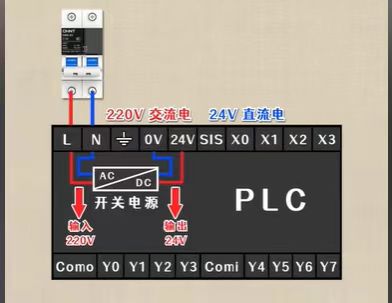
The primary driver for a dual-power configuration is the need for physical isolation between the internal control core and the external field equipment.
In a professional setup, the "Main Power Supply" is dedicated exclusively to the critical internal components: the PLC CPU, I/O modules, and communication hardware. Meanwhile, a completely independent "Auxiliary Power Supply" provides electricity to peripheral devices such as field sensors and actuators.
- Failure Containment: By cutting off the fault propagation path between the core and the periphery, this physical isolation ensures that the control core remains absolutely stable.
- Segmented Protection: If a sensor in the field experiences a short circuit or overcurrent, the surge is confined to the auxiliary circuit, preventing the PLC itself from rebooting or sustaining hardware damage.
2. Mitigating Electrical and Electromagnetic Interference
Industrial environments are notoriously "noisy" in an electrical sense. The frequent starting and stopping of motors, along with the high-frequency switching of Variable Frequency Drives (VFDs), generate intense electromagnetic interference.
- The "Firewall" Effect: Utilizing independent power channels acts as an electrical "firewall" for the control system.
- Performance Metrics: Empirical testing demonstrates that systems using isolated power configurations can improve their anti-interference capability by more than 60%.
- Signal Integrity: This configuration ensures that precision signals—vital for high-precision automation—are not corrupted by the electrical noise of field actuators.
3. Redundancy and Reliability through Design
Redundancy is a cornerstone of professional industrial control. Statistics indicate that in single-power supply scenarios, power-related failures account for up to 35% of all system downtime.
- Continuous Operation: With a dual configuration, even if one power module fails, the other can often maintain critical functions, preventing a total production halt.
- Case Study Evidence: Case studies from automotive production lines show that switching to a dual-power configuration reduced downtime caused by power failures by 82%.
- Smart Diagnostics: Modern high-end power modules often include "self-diagnosis" features that provide early warnings for potential issues, allowing maintenance teams to intervene before a failure occurs.
4. Operational Practicality and Maintenance Efficiency
From a maintenance perspective, a segmented power design significantly simplifies the troubleshooting process. This aligns with Yushine's focus on "Operational Practicality" and providing the "smoothest experience" for the end-user.
- Rapid Fault Isolation: When an external device shorts out, an independent fuse terminal can immediately cut power to that specific branch without affecting any other devices in the system.
- Reduced Repair Time: Experience in the field suggests that this design can shorten fault localization time by 70%.
- Improved MTTR: In large-scale petrochemical applications, implementing this scheme reduced the average time to repair (MTTR) from 45 minutes down to just 12 minutes.
5. Future-Proofing and System Scalability
As factories grow and production lines are upgraded, power requirements naturally increase. A dual-architecture configuration inherently provides superior scalability.
- Simplified Expansion: Upgrading the system simply requires adding new supply branches to the existing auxiliary circuits.
- Cost Savings: Evidence from "intelligent transformation" projects in the food processing industry proves that using dual-power control cabinets saved 40% in renovation costs during capacity expansion.
- Optimized for Distributed I/O: This architecture is especially beneficial for distributed I/O systems, where each node can benefit from independent power supply advantages.
Conclusion: A Machine Worthy of Trust
Installing two separate 24V power supplies in a PLC cabinet, complemented by a branched protection design, is far from unnecessary. It is a sophisticated, "User-Centric" engineering solution that maximizes system availability and maintainability.